
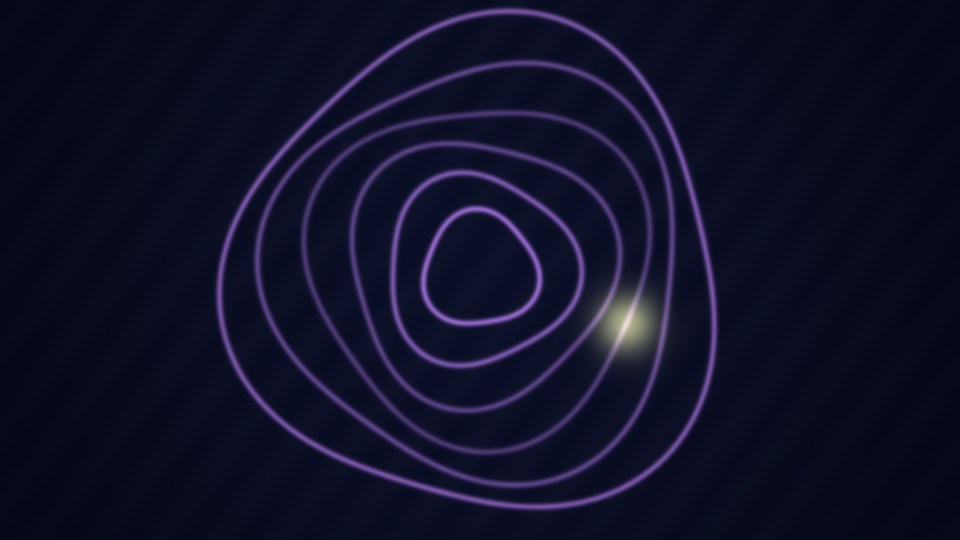
 STILL FROM ORBIT STUDY · ORIGINAL ARTWORK
Establish a recognizable rule
A visual system becomes easier to read when a viewer can infer its structure. Repeated rows, consistent spacing, or concentric circles provide a sense of order. Once that order is established, small changes become more visible.
Quiet Grid uses a measured background grid, so a bright moving node has a clear frame of reference. The grid does not need to move dramatically to make the image feel active.
Introduce variation selectively
If every element is different, there is little pattern left to recognize. The trick is to keep enough consistency for the original rule to remain legible while changing the timing, position, or brightness of only a few components.
An orbit is especially useful for this approach. A single moving marker on a circular path quickly suggests motion, while subtle changes to surrounding rings add visual interest without destroying the composition.
Use scale as a storytelling tool
A dense field can look like texture from a distance but become a collection of individual parts when viewed closely. This dual reading helps geometric animation work at different screen sizes.
Before finalizing a pattern, check whether the smallest elements are still meaningful on mobile. If they dissolve into noise, emphasize the larger structural rhythm instead.
Do not confuse art with measurement
System-inspired graphics can resemble scientific or engineering dashboards. If the work does not visualize real measurements, say so clearly. Aesthetic similarity is not a substitute for accurate data.
The studies on this site are computer-generated artistic exercises. Orbit Study is not astronomical footage and Quiet Grid is not a live network visualization. Their purpose is to explore composition rather than to report real-world conditions.
See the idea in motion.
Watch the related original study and notice how the principles described above come together in a short, silent animation.
Watch Orbit Study ↗