
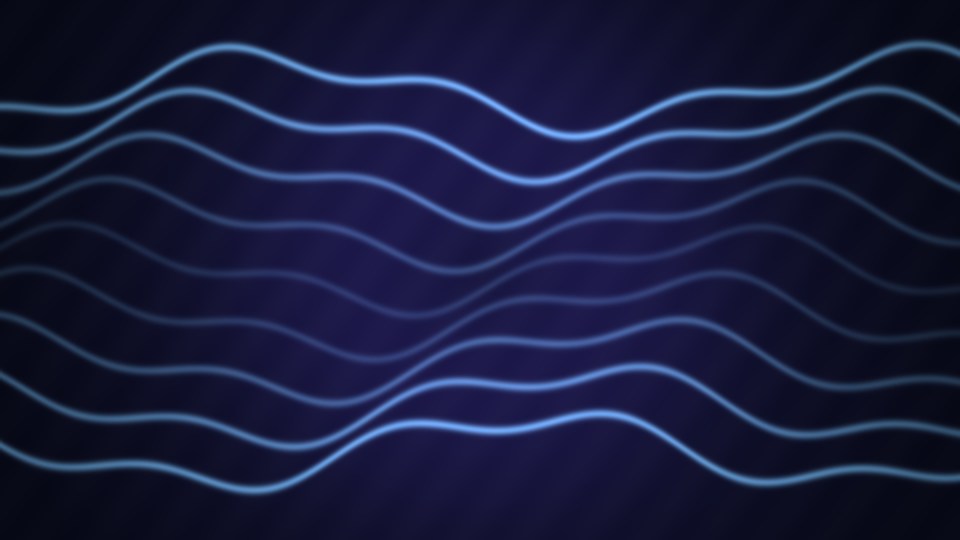
 STILL FROM PHASE LINES · ORIGINAL ARTWORK
Start with one repeatable idea
A seamless visual loop begins with a condition that can return to where it started. A line can rise and fall. A point can trace a circle. A color can pass through a sequence and come back to its original value. Keeping the first idea simple makes it easier to understand what each added detail contributes.
For the experiments on Aiximedia Edge, we often work with mathematical functions because they can produce predictable motion. That predictability is helpful when you want an animation that plays repeatedly without drawing attention to its start or end.
Think in cycles, not just seconds
A video can be seven seconds long without actually being a seamless cycle. The underlying shapes must also reconnect at the boundaries. For example, a rotating point completing one full turn naturally returns to its starting position; a drifting point may not.
When planning a loop, pick a period, map each element to that period, and verify the first and final visible states. A slightly mismatched transition can be especially noticeable in slow, minimal compositions.
Use restraint to create hierarchy
Adding many layers can make an animation feel complex, but it can also hide the central motion. Try working with a background field, one primary animated element, and one supporting accent. Let contrast and timing show viewers where to look.
In Phase Lines, the repeated lines are the subject. Light variations in their position and brightness provide depth without needing a camera move or a scene change.
Review it in the real browser
Export a common video format such as H.264 MP4 for broad browser support, then test actual playback rather than trusting a static preview. Check the first frame, the transition at the loop point, and whether the poster image represents the clip accurately.
Also watch at phone size. Tiny line details can disappear on small screens or under bright ambient light. Increasing contrast or simplifying the pattern often improves legibility more than adding resolution.
See the idea in motion.
Watch the related original study and notice how the principles described above come together in a short, silent animation.
Watch Phase Lines ↗